Epic sued Apple and Google on the same day in 2020, over the same 30% cut. Against Apple, Epic lost its antitrust case. Against Google, a jury sided with Epic on every question. The court record shows what Google paid to stay on top: a Google executive testified that Google expected to pay Samsung about $8 billion over four years, and under Project Hug, top game makers got cash and other benefits not to launch on rival stores. The verdict was upheld and the order is in force. Since July 2026, rival app stores can be installed from inside Google Play; by the end of September, one had. The full case file, from the public record: the cut, the gate, the deals, the verdict, and what changed.
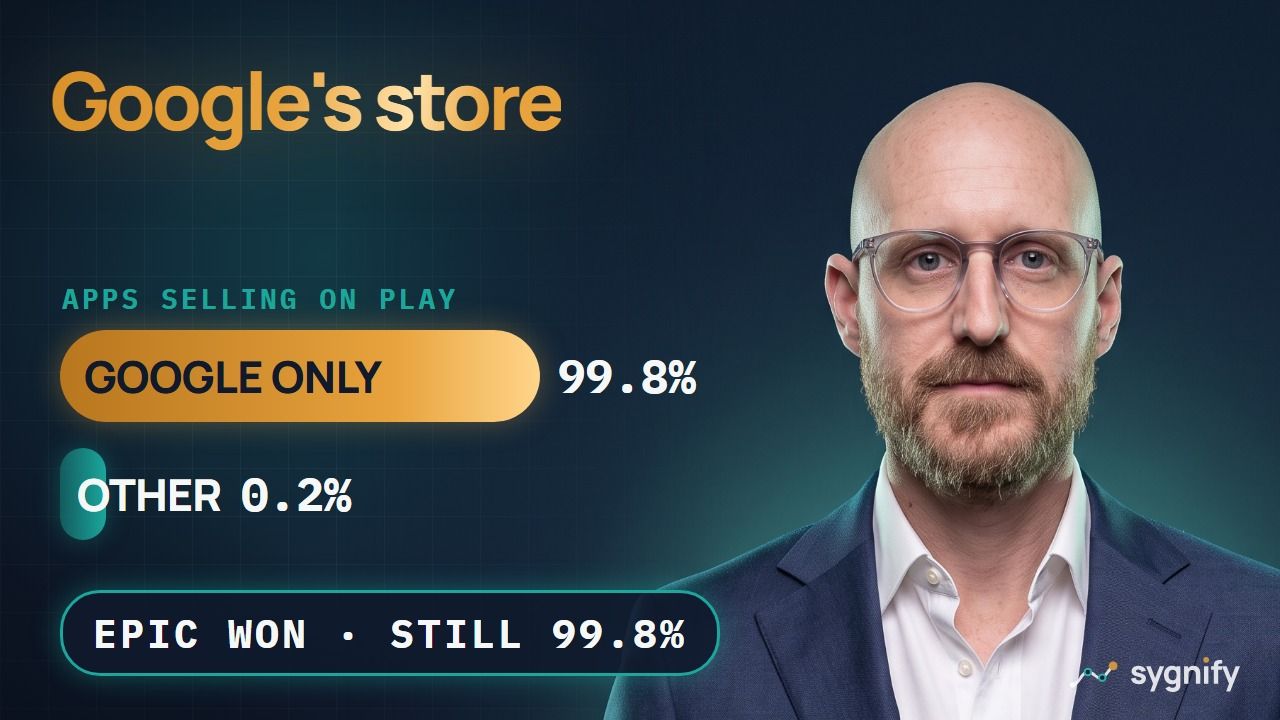
of apps selling on Google Play still bill only through Google, as of 30 Sep 2026. Google's data, our arithmetic.
GOOGLE COMPLIANCE DATA, 15 OCT 2026, P. 6yes-or-no questions on the verdict form, all answered for Epic.
VERDICT FORM, 11 DEC 2023, PP. 1 TO 6what Google expected to pay Samsung over four years, a Google executive testified. Testimony, not a finding.
TRIAL TRANSCRIPT VOL. 6, TR. 1110 TO 1111What the record is. The jury found Google unlawfully kept monopoly power in Android app distribution and in-app billing, in markets defined worldwide excluding China; the judge's order applies in the United States, and the appeals court affirmed it. The Samsung figure is trial testimony (Google's estimate), not a finding. The settlement Epic and Google filed was withdrawn before any ruling. The compliance counts are Google's own data; 99.8% is our arithmetic.
| Number | What it is | Where |
|---|---|---|
| 7 of 7 | Yes-or-no questions answered for Epic; markets worldwide, excluding China | Verdict form pp. 1 to 6 |
| 95% | U.S. Android app downloads through Google Play, as of 2020 | 9th Cir. op. p. 14 |
| About $8B | What Google expected to pay Samsung over four years (testimony) | Trial tr. vol. 6, 1110 to 1111 |
| $360M / $243M | Project Hug offer to Activision Blizzard / the loss a year Google estimated it risked | Post-trial order p. 17 |
| 1 store, 28 apps | Rival app stores published inside Google Play, as of 30 Sep 2026 | Compliance data p. 3 |
| 853 of 399,291 | Apps selling on Play that offer another way to pay, 30 Sep 2026 | Compliance data p. 6 |

Open the documents above. Every number in the video points to its page.
Subscribe for the next fileEpic sued Apple and Google on the same day in 2020, over the same 30% cut. Against Apple, Epic lost its antitrust case. Against Google, a jury sided with Epic on every question. The court record shows what Google paid to stay on top: a Google executive testified that Google expected to pay Samsung about $8 billion over four years, and under Project Hug, top game makers got cash and other benefits not to launch on rival stores. The verdict was upheld and the order is in force. Since July 2026, rival app stores can be installed from inside Google Play; by the end of September, one had. The full case file, from the public record: the cut, the gate, the deals, the verdict, and what changed.
of apps selling on Google Play still bill only through Google, as of 30 Sep 2026. Google's data, our arithmetic.
GOOGLE COMPLIANCE DATA, 15 OCT 2026, P. 6yes-or-no questions on the verdict form, all answered for Epic.
VERDICT FORM, 11 DEC 2023, PP. 1 TO 6what Google expected to pay Samsung over four years, a Google executive testified. Testimony, not a finding.
TRIAL TRANSCRIPT VOL. 6, TR. 1110 TO 1111What the record is. The jury found Google unlawfully kept monopoly power in Android app distribution and in-app billing, in markets defined worldwide excluding China; the judge's order applies in the United States, and the appeals court affirmed it. The Samsung figure is trial testimony (Google's estimate), not a finding. The settlement Epic and Google filed was withdrawn before any ruling. The compliance counts are Google's own data; 99.8% is our arithmetic.
| Number | What it is | Where |
|---|---|---|
| 7 of 7 | Yes-or-no questions answered for Epic; markets worldwide, excluding China | Verdict form pp. 1 to 6 |
| 95% | U.S. Android app downloads through Google Play, as of 2020 | 9th Cir. op. p. 14 |
| About $8B | What Google expected to pay Samsung over four years (testimony) | Trial tr. vol. 6, 1110 to 1111 |
| $360M / $243M | Project Hug offer to Activision Blizzard / the loss a year Google estimated it risked | Post-trial order p. 17 |
| 1 store, 28 apps | Rival app stores published inside Google Play, as of 30 Sep 2026 | Compliance data p. 3 |
| 853 of 399,291 | Apps selling on Play that offer another way to pay, 30 Sep 2026 | Compliance data p. 6 |
Open the documents above. Every number in the video points to its page.
Subscribe for the next file